
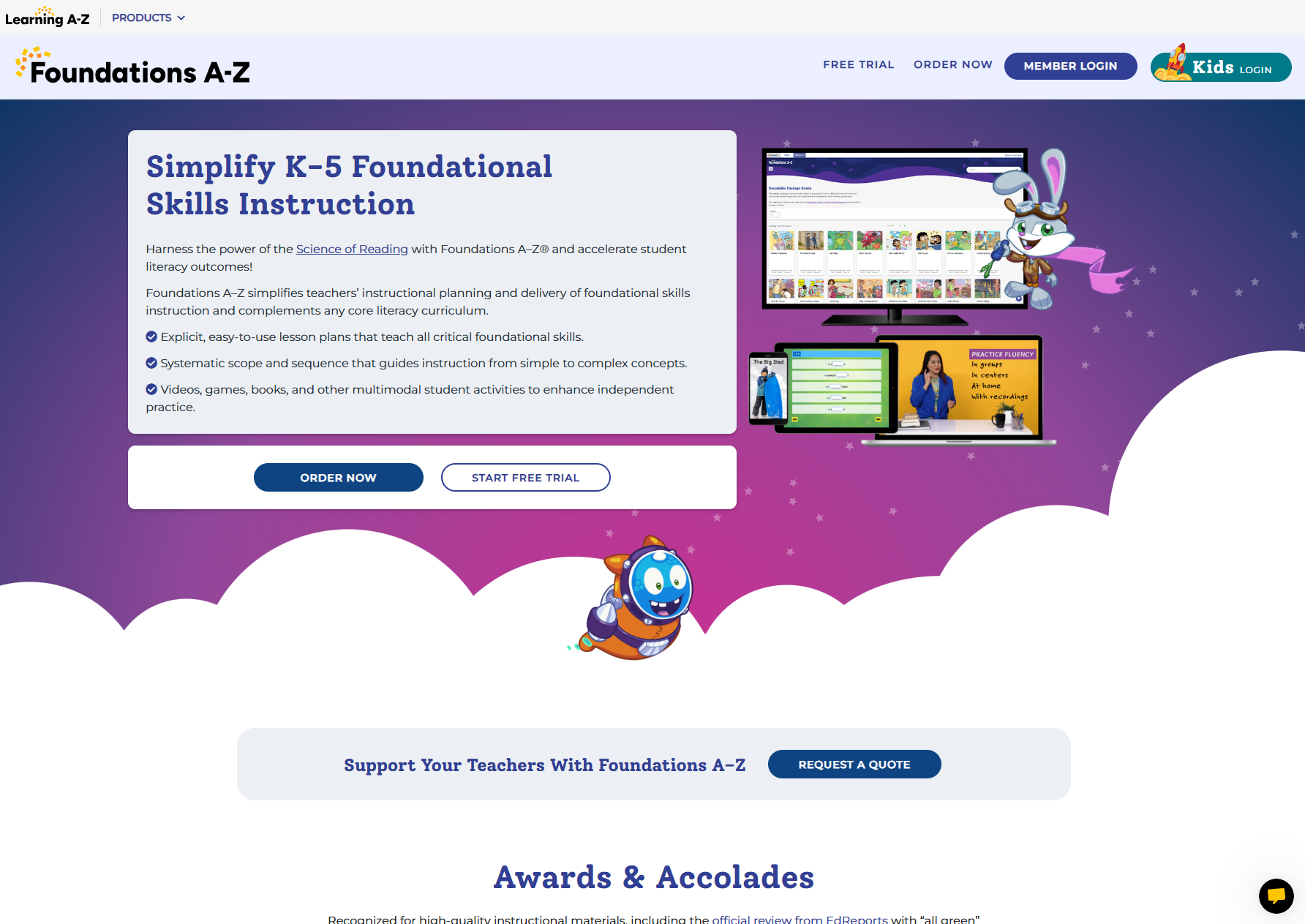
Foundations A-Z
The Problem
Schools and educators lacked a unified, scalable way to access structured foundational learning resources. Existing solutions were fragmented, hard to navigate, and not aligned with how educators actually plan instruction.
The Challenge
This wasn’t a redesign—it was a brand new product concept/build.
Key challenges included:
- No existing patterns or product foundation
- Aligning multiple stakeholders (learning + product + business)
- Designing for multiple user types (teachers, admins, etc.)
- Ensuring the system could scale over time
ROLE
Lead UX Designer & Front-end Engineer
Timeline
2 years
Team
Product Manager + Learning Designers + Engineering
Impact
Transformed a fragmented set of learning resources into a cohesive, scalable product experience. By aligning content structure, navigation, and user workflows, the platform significantly improved how educators discover, access, and use materials—while laying the groundwork for long-term product and content scalability.
My Approach
1. Understanding Educator Needs
I worked closely with Learning Designers and stakeholders to understand:
- How educators plan lessons
- How they search for and use content
- Where existing tools created friction
Key insight:
Teachers don’t think in “content structures”—they think in instructional flow and outcomes.
2. Defining the System
Instead of designing isolated screens, I focused on:
- Structuring content in a way that scales
- Creating consistent patterns across the experience
- Supporting both discovery and guided use
This required aligning:
- Content models
- Navigation systems
- Metadata structures
3. Designing for Flexibility
The platform needed to support:
- Different user roles
- Different teaching styles
- Evolving content over time
I prioritized:
- Modular design patterns
- Flexible navigation
- Clear hierarchy of information
4. Cross-functional Collaboration
This project required deep collaboration with:
- Learning Designers (content structure + pedagogy)
- Product Managers (prioritization + scope)
- Engineers (feasibility + scalability)
A key part of my role was translating between disciplines and aligning on decisions.
Design Evolution
Early concepts focused heavily on structured navigation, but testing and feedback revealed:
Users needed a balance between structure and flexibility.
This led to:
- Iterating on navigation patterns
- Refining how content was grouped and surfaced
- Simplifying interaction flows
Outcome
The result was a scalable platform that:
- Provided a clear, structured way to access foundational content
- Reduced friction in finding and using resources
- Created a foundation for future growth and expansion
Reflection
What I Learned
- Designing systems is more about structure and relationships than screens
- Early alignment across teams prevents major downstream issues
- Flexibility is just as important as clarity in complex products
If I were to approach this today, I would:
- Invest earlier in validating content structure with users
- Explore more lightweight testing earlier in the process
- Push for clearer success metrics from the start
Designed and launched a scalable learning platform from scratch
Let’s Work Together
Tell me about your project, team, or opportunity.
I design experiences that turn complexity into clarity—and ideas into products people actually use. Whether you’re looking for help with a website, SaaS product, or UX strategy—or exploring a full-time role—I’d love to connect and see how I can help.
Feel free to reach out using the form below, or download my resume

